Twelve months. Twelve Bolivias.
Researching the book put me in rooms with extraordinary people, more than any single trip could hold. So I stopped trying to build one trip and built twelve: a signature route for each month, shaped around what that region does best in that season. Almost nobody travels just one.
“The calendar tells you when Bolivia is at its best. What we build from it is yours.”Calvin Korponai
Each of the twelve is deliberately different. Some lean hard into the outdoors: salt flats, volcanoes, cloud forest, long horizons. Others focus on culture and craft: mission baroque, healers’ country, the first empire of the Andes. A few center on the table, because Bolivia’s food and wine rank among the least known on the continent. Each one also leans a little past the comfortable. Not far. Just enough.
In practice, we rarely run one as written. We mix and match: we stitch two routes together, stretch one, or swap a leg for what your dates or the season ask for. The twelve are the raw material. We build the trip around your situation.
Twelve signature routes, one for each month.
We order the routes by when their corner of the country is at its best. Each one stands alone and is written out in full, day by day. Ask, and I’ll send you all twelve. Then we can talk about which parts are actually yours.
-
Jan01
The Flooded Salar
The rains turn the world’s largest salt flat into a perfect mirror. For a few weeks, you drive straight across the sky.
La Paz → Uyuni → Tahua · Thunupa
Landscape -
Feb02
Sud Lípez Lagoons
Red and green lagoons at altitude, wind-carved stone trees, and flamingos on the high desert of the far south.
Uyuni → Laguna Colorada → Siloli → Árbol de Piedra
Landscape -
Mar03
Tiwanaku & Titicaca
The Gate of the Sun, the sacred lake and the Island of the Sun: the first great civilization of the high Andes.
La Paz → Tiwanaku → Copacabana → Isla del Sol
Archaeology -
Apr04
Tarija & the Southern Table
High-altitude tannat, singani straight from the still, and the long southern lunches that go with them.
Tupiza → Tarija → Valle de la Concepción
WineThe table -
May05
Machu Picchu → Titicaca
Start with the place everyone knows, then cross the border into the one they don’t. Peru as the proof of concept.
La Paz → Cusco → Machu Picchu → Puno → Copacabana
Peru + Bolivia -
Jun06
Sajama & the Dry Altiplano
Bolivia’s highest peak, ancient rock, and the country’s clearest case for the beauty of sheer altitude.
La Paz → Pumiri → Sajama National Park
Landscape -
Jul07
Samaipata & Amboró
A vast carved rock, cloud-forest birding and giant tree ferns, where the Andes bend down toward the lowlands.
Santa Cruz → Samaipata · El Fuerte → Amboró NP
ArchaeologyBiodiversity -
Aug08
Chiquitanía Missions
Jesuit mission churches in full baroque, with painted ceilings where the angels wear the faces of the people who painted them.
San Javier → Concepción → San Ignacio → San Rafael → San José
CultureArchitecture -
Sep09
Llanos de Moxos & Beni
Lost earthwork cities on the flooded plains, wildlife on the Yacuma, and cacao growing wild in the forest.
La Paz → Rurrenabaque → Yacuma · Casarabe mounds
ArchaeologyThe table -
Oct10
Yungas Cloud Forest
The old road drops off the high plateau into cloud-forest birding and the Afro-Bolivian valleys of Coroico.
La Paz → Coroico → Tocaña → Cotapata
LandscapeLiving culture -
Nov11
Apolobamba
The high, remote country of the Kallawaya, travelling healers whose knowledge is its own kind of archive.
La Paz → Curva → Akhamani → Cololo
Living culture -
Dec12
Cochabamba & Toro-Toro
Markets and chicherías in the country’s kitchen, then a canyon floor printed with dinosaur tracks.
Cochabamba → Toro-Toro National Park
The tableLandscape
Seasons drive the calendar. The salt flat floods in January and turns dry and firm by June; the eastern lowlands are navigable only from July to September. Seasons also explain why finished trips rarely match the list. Tell me when you can travel, and I’ll tell you what the country is doing then. Each window is short, so plan about three months ahead for the month you want.
Altitude & horizon
Salt flats, volcanoes, high lagoons and cloud forest. Long days outside, thin air, and landscapes that feel larger than any photograph. For travellers happiest with a horizon in front of them.
Culture & history
Mission baroque, Andean ruins, healers’ country and living tradition. For people who travel to understand a place rather than tick it off, with a guide who can explain why it matters.
Food & wine
Tannat and singani in the south, wild cacao in the Beni, market kitchens and chicherías in Cochabamba. Several of the twelve center on food, and the others bend toward it easily.
A step past comfortable
Never fully roughing it, never resort-soft. Every route takes you a little past the familiar: a rougher road, a longer day, a place off the usual map. That is where the good part is.
A starting point, not a menu.
These are the twelve routes I would argue for hardest, but most trips end up as a combination: two months joined, one stretched past the usual seven days, or a section dropped for a place you can’t let go of.
Want something else entirely? We design it from scratch.
Start a conversation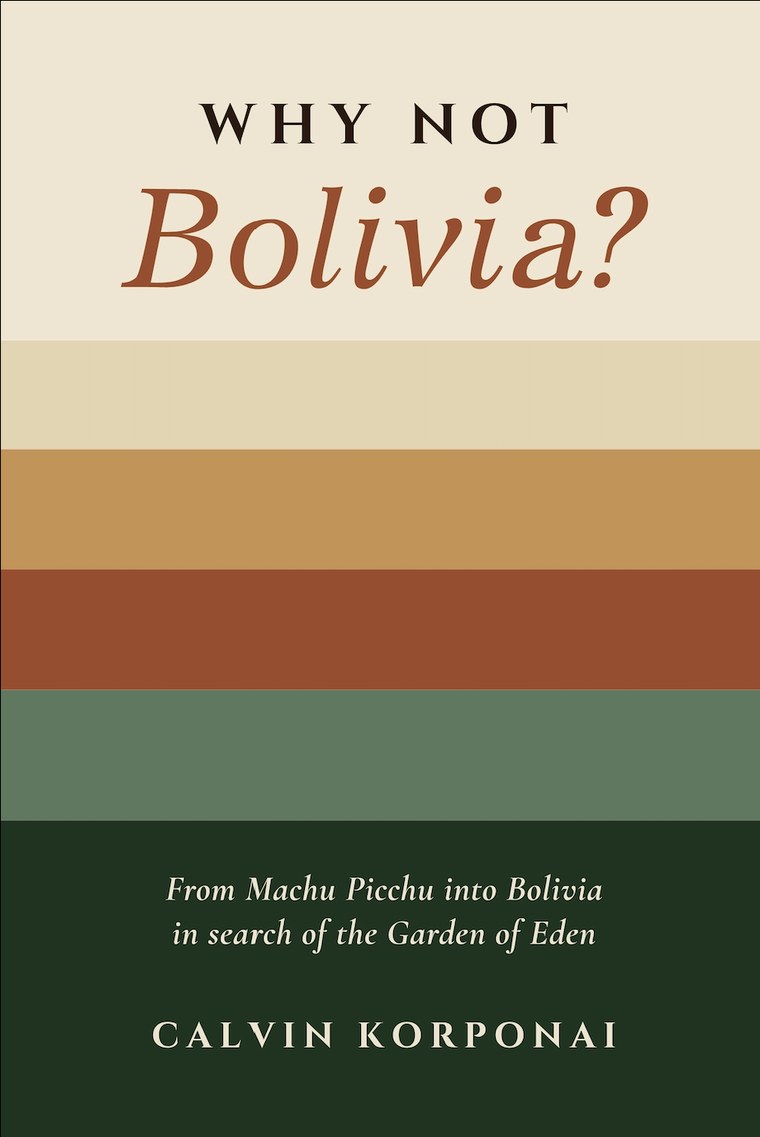
More than a travel guide.
Why Not Bolivia? argues that the most extraordinary country in South America has stayed hidden from the world by design, not by accident. Read it before you set foot in Bolivia, or whenever the search for Eden draws you in.
The book starts with Peru: how Lima became a global food capital, how Machu Picchu grew into a twenty-billion-dollar industry, and what that success has cost. Peru is not a model to copy. It is a mirror, a record of choices Bolivia can learn from.
Part Two turns to Bolivia: the Salar de Uyuni, Tiwanaku, La Paz, the Llanos de Moxos, Potosí, the Yungas, cholita culture and the Tarija wine valleys. Each chapter builds toward the central case. Bolivia never built a major tourism industry, and the reason isn’t a lack of assets. Nobody has told its story.
Why Not Bolivia? tells it.